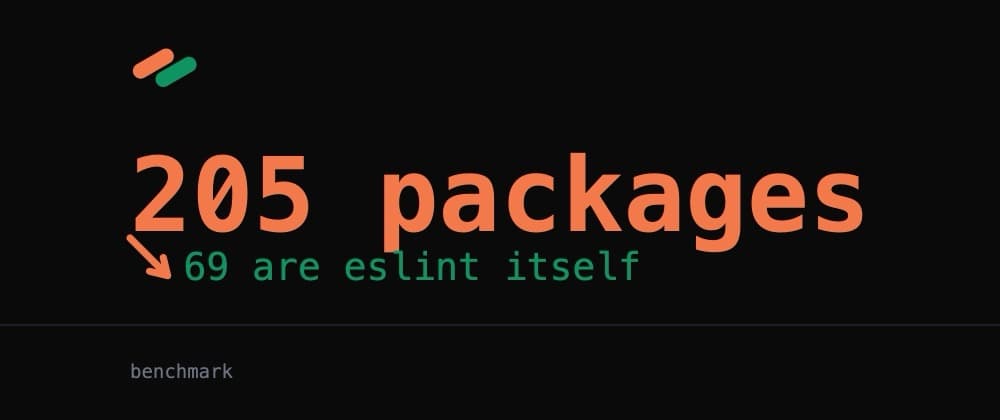
npm i -D eslint-plugin-import installs 205 packages.
That number is true and almost useless, which is the problem with every dependency-weight argument I have read. 69 of those packages are ESLint itself. Since npm 7, peer dependencies install automatically, so any plugin declaring eslint as a peer drags the entire linter into the count — and every plugin should declare it that way.
So I measured the baseline first, then subtracted it.
What each plugin actually adds
Resolved with npm install --package-lock-only into an empty project, one plugin at a time, on 2026-08-12. Bare eslint alone resolves to 69 packages — that is the zero point.
| plugin | tree | adds | direct deps |
|---|---|---|---|
| eslint-plugin-import | 205 | 136 | 19 |
| eslint-plugin-react | 204 | 135 | 18 |
| eslint-plugin-jsx-a11y | 194 | 125 | 15 |
| eslint-plugin-unicorn | 110 | 41 | 20 |
| eslint-plugin-sonarjs | 83 | 14 | 13 |
| eslint-plugin-n | 80 | 11 | 8 |
| eslint-plugin-promise | 70 | 1 | 1 |
Now look at the two columns on the right together, because they do not agree.
eslint-plugin-promise declares one direct dependency and adds one package. eslint-plugin-unicorn declares twenty and adds 41. eslint-plugin-sonarjs declares 13 and adds 14. But eslint-plugin-import declares 19 and adds 136 — seven per declared dependency, because its dependencies have dependencies.
Direct dependency count does not predict install weight. It is the number people quote, including me before I measured it, because it is the one visible on the npm page without resolving anything.
The number you actually install
Nobody installs one plugin. A conventional React setup:
npm i -D eslint eslint-plugin-react eslint-plugin-jsx-a11y eslint-plugin-import228 packages. Not 69 + 135 + 125 + 136 — the trees overlap heavily and npm dedupes them, so the sum is far less than the parts. That is the other half of why per-plugin numbers mislead: they are neither additive nor independent.
Where mine land
I maintain a plugin suite, so here is my own row, measured identically:
| plugin | tree | adds | direct deps |
|---|---|---|---|
| eslint-plugin-react-features | 71 | 2 | 1 |
| eslint-plugin-modernization | 71 | 2 | 1 |
| eslint-plugin-browser-security | 71 | 2 | 1 |
| eslint-plugin-import-next | 97 | 28 | 2 |
Two packages: one shared internal toolkit, which itself has zero dependencies, plus the plugin. import-next adds 28 because it carries a real resolver — that is the trade it makes for being much faster.
I am not the leanest here and I want to be precise about that: eslint-plugin-promise adds one package and I add two. If dependency weight is your only axis, promise is the leaner choice.
One more honest reading of the table. eslint-plugin-security resolves to 3 packages total — the smallest number on this page by a wide margin. It does not declare eslint as a peer dependency at all, which is why the 69-package baseline never appears, and it is the plugin I have argued elsewhere is unmaintained. A small tree is not a proxy for a healthy package. It can just mean the package stopped changing.
How to check yours
mkdir /tmp/w && cd /tmp/w && npm init -y >/dev/null
npm i --package-lock-only <plugin>
node -e "console.log(Object.keys(require('./package-lock.json').packages).filter(k=>k.startsWith('node_modules/')).length)"
--package-lock-only resolves the graph without downloading anything, so it runs in about a second. Measure bare eslint first, subtract, and compare like with like. Then measure the union you actually install, because that is the only number that reaches your node_modules.
Every figure above was resolved on 2026-08-12 and will drift as these packages release. Re-run the four lines above rather than citing mine.
Re-run on 2026-09-04, all fourteen numbers on this page came back identical — the 69-package baseline, every plugin tree, and the 228-package combined install. Three weeks of ecosystem churn moved none of them, which is itself the finding: these trees are stable because the packages at the top of the table are not releasing.
Run it on your config — what's the gap between the packages you asked for and the packages you got?
[📦 npm i -D eslint-plugin-react-features — two packages, and you can check that number with the four lines above before you install it. If it earns its place in your CI, ⭐ star the repo.](https://www.npmjs.com/package/eslint-plugin-react-features)
eslint-plugin-react-features is part of the Interlace ESLint ecosystem — every tree in the table above is measurable the same way. Source on GitHub · Follow: Dev.to/ofri-peretz