I maintain burgee, nine CLI packages, and counted them against the stack they replace, one usual package per layer:
npm i commander chalk ora inquirer string-width cosmiconfig execa signal-exit terminal-link70 packages, maintained by 25 npm accounts. burgee's nine install 9 packages from 1 account.
That is the flattering row. Part 1 printed the rows against my plugins; same method, same rule here.
Layer by layer
Each incumbent is the first whole package in burgee's own "Replaces" column (the terminal row lists half of ansi-escapes first; with it, 66 packages), so the stack comes from my design surface, not a neutral sample. Resolved 2026-09-23, one package at a time; KB is 1,024 bytes of files, whole tree included.
| incumbent | pkgs | KB | burgee family | pkgs | KB |
|---|---|---|---|---|---|
| commander@15.0.0 | 1 | 203 | burgee@0.10.0 | 6 | 1169 |
| chalk@6.0.0 | 1 | 55 | roundel@0.4.3 | 1 | 76 |
| ora@9.4.1 | 17 | 278 | flagstaff@0.3.7 | 5 | 546 |
| inquirer@14.2.2 | 27 | 1002 | caique@0.4.3 | 3 | 302 |
| string-width@8.2.2 | 4 | 36 | linegauge@0.4.4 | 1 | 83 |
| cosmiconfig@10.0.1 | 4 | 1789 | seniority@0.4.3 | 1 | 149 |
| execa@10.0.1 | 18 | 632 | bellpull@0.2.3 | 1 | 96 |
| signal-exit@4.1.0 | 1 | 75 | closeout@0.4.1 | 1 | 100 |
| terminal-link@5.0.0 | 6 | 60 | paratext@0.5.4 | 1 | 91 |
On bytes, burgee's side is heavier in six of nine layers. Installed together, the incumbents weigh 3,851 KB; burgee, 1,577. The incumbent trees overlap (79 summed, 70 installed); burgee's overlap completely (20 summed, 9 installed).
Where that byte gap comes from
Three layers carry it, none cleanly.
- cosmiconfig is 1,789 KB, and 1,702 of that is js-yaml and its argparse. seniority parses no YAML: it reads the JSON subset and refuses the rest by name. Against cosmiconfig's own test suite it passes 186 of 243.
- execa has no graded drop-in. bellpull's compat row is cross-spawn, not execa.
- inquirer is graded through
@inquirer/core(41 of 41), notinquireritself.
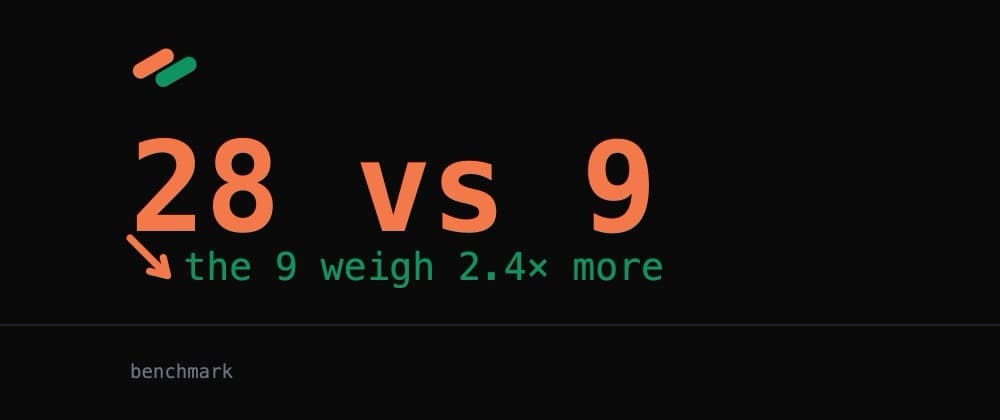
Keep only layers where burgee's drop-in scores what the incumbent scores on its own suite: commander, chalk, ora, @inquirer/core@12.0.3, string-width, signal-exit (not terminal-link: 8 of 10). 28 packages, 662 KB. burgee still installs all nine (sibling dependencies pull in the other three), 1,577 KB. Like for like, burgee is 2.4× heavier on disk, while the count stays 28 against 9, maintainers 14 against one.
The three gates burgee publishes as not met
burgee's README states nine gates; three fail their ≤ 1.0× target. I re-ran each with burgee's own fixtures:
| gate | published | re-run |
|---|---|---|
burgee bundle vs cac | 2.636× | 2.661× |
burgee/commander bundle vs commander | 1.514× | 1.520× |
| cold start vs cac | 1.443× | 1.67–2.31× |
The bundle rows agree within a percent. The cold-start re-runs, at load average above 80, read worse than burgee's published figure. Either way, not met. burgee's parity rows compare its bundles against cac, commander or yargs plus cosmiconfig, exit-hook and restore-cursor (0.282×, 0.468×, 0.531×). Those stacks include cosmiconfig, which my like-for-like rule excludes.
What "zero dependencies" means here
Six of nine declare no dependencies. burgee, flagstaff and caique depend only on those six: no dependency outside the family, which is not zero. burgee's README table says 0 runtime dependencies; the registry lists five, all siblings.
One account is also a concentration. Mid-measurement, my pipeline published burgee@0.10.0 at 05:34 UTC, then the closeout and linegauge it requires at 05:39 and 05:42; for eight minutes npm i burgee failed with ETARGET. And the family declares Node 24, where the incumbent stack's floor is Node 22.18. If you support Node 22.18, the incumbents are your option.
How to check yours
Part 1's method, plus bytes and maintainers:
cd "$(mktemp -d)" && npm init -y >/dev/null
npm i --package-lock-only <your dependencies>
node -e "console.log(Object.keys(require('./package-lock.json').packages).filter(k=>k.startsWith('node_modules/')).length)"
npm ci --ignore-scripts && node -e "let t=0;const f=require('fs'),w=d=>f.readdirSync(d,{withFileTypes:true}).forEach(e=>{const p=d+'/'+e.name;e.isDirectory()?e.name!=='.bin'&&w(p):e.isFile()&&e.name!=='.package-lock.json'&&(t+=f.statSync(p).size)});w('node_modules');console.log(t)"
node -e "const l=require('./package-lock.json').packages,m=new Set(),u=[];Promise.all(Object.keys(l).filter(k=>k.startsWith('node_modules/')).map(k=>fetch('https://registry.npmjs.org/'+k.split('node_modules/').pop().replace('/','%2F')).then(r=>r.ok?r.json():Promise.reject()).then(d=>(d.maintainers||[]).forEach(x=>m.add(x.name))).catch(()=>u.push(k)))).then(()=>console.log(m.size,'unfetched',u.length))"
Part 1 subtracted a 69-package ESLint baseline; here the shared baseline is Node, zero packages. pnpm, yarn 1 and bun resolve the same counts. The family ships often and its caret ranges float: pin all nine as tabled, or expect drift.
Run it on your CLI: how many npm accounts can ship code into your tree, and did you know that number before today?
[If the method earns a place in your release review, ⭐ star burgee.](https://github.com/ofri-peretz/burgee)